

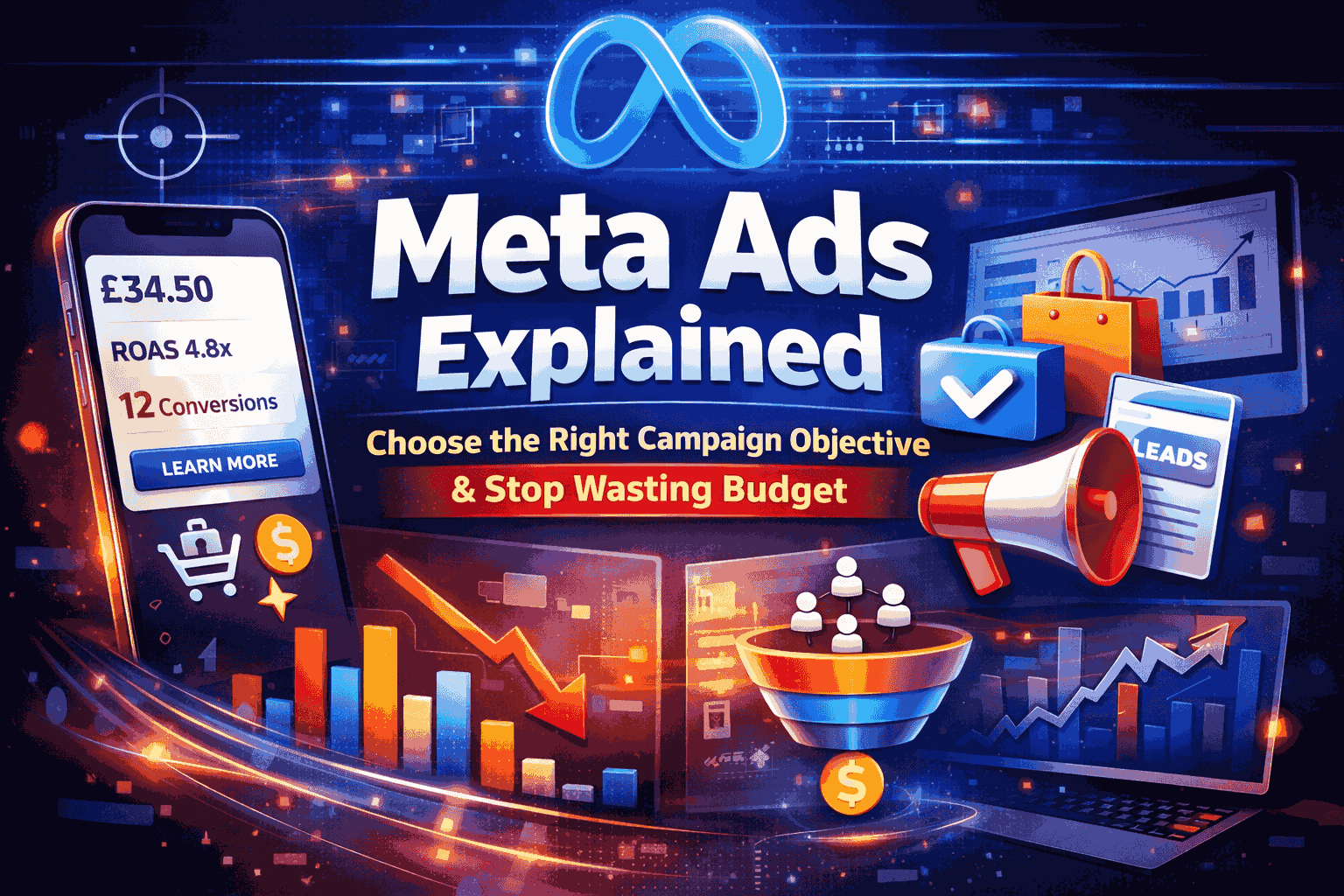
If you choose the wrong Meta Ads objective, the algorithm can still “perform” but it will optimize for the wrong result. Here’s how to pick the right campaign every time (and what each objective is actually designed to generate).
How Meta Ads really works
When you run ads, you’re not just “boosting a post.” You’re entering an ad auction every time your ad could appear. Meta’s system uses an auction to decide which ad to show to a person at a given moment, aiming to maximize value for both people and businesses.
Behind the scenes, your results are heavily influenced by 3 things:
- Your objective + performance goal (what you’re asking Meta to optimize for)
- Your ad set settings (audience, placements, budget, schedule)
- Your tracking signals (Pixel + Conversions API data that tells Meta what happened after the click)
The campaign structure (Campaign → Ad Set → Ad)
Meta Ads is built in 3 layers:
- Campaign level: you choose the objective (what success means).
- Ad set level: you define audience, placements, budget, schedule.
- Ad level: you add the creative (image/video), copy, and CTA.
This matters because the objective you pick at campaign level affects what options you’ll see later (conversion locations, performance goals, optimization events, etc.).
The 6 campaign objectives (what each one generates)
Meta consolidated objectives into six: Awareness, Traffic, Engagement, Leads, App Promotion, Sales.
Below is what each one is designed to generate, and how marketers typically use it.
1) Awareness
What it generates: Reach, impressions, ad recall (top-of-funnel visibility).
How it works: You’re telling Meta: “Show my ad to people most likely to remember it / maximize reach.” Some older “Reach” setups are now created under Awareness.
Best for:
- Brand launches
- New market entry
- Announcements, events, seasonal pushes
What to measure: Reach, frequency, CPM, ad recall lift (when available).
2) Traffic
What it generates: Clicks or high-quality visits (landing page views) to a destination like a website.
How it works: Traffic focuses on sending people to your destination, and Meta allows different performance goals such as link clicks or landing page views (LPV is often higher-quality because it optimizes for people likely to click and fully load your page).
Best for:
- Blog content distribution
- Awareness + retargeting setup
- Driving people to a specific page (offer page, service page, article)
What to measure: Landing page views, cost per LPV, time on page (if you track it), scroll depth/events.
3) Engagement
What it generates: Actions on-platform (and sometimes messaging) like:
- video views
- post engagement (likes/comments/shares/saves)
- Page likes / event responses
- messages (depending on conversion location)
How it works: Engagement is not “more sales.” It’s “more interactions” — and that can be great if your goal is attention, social proof, and conversations.
Best for:
- Reels/video growth
- Community building
- “Proof-first” campaigns (social proof before conversion)
What to measure: Cost per engagement, saves/shares, video watch metrics, cost per conversation (for messaging paths).
4) Leads
What it generates: Lead submissions (and sometimes calls/messages depending on setup).
How it works: Leads can be collected through Instant Forms (native Meta lead forms) or other conversion locations depending on how you configure it.
Instant Forms are a common path when you want quick lead capture with low friction.
Best for:
- Service businesses (clinics, agencies, real estate, education, etc.)
- B2B lead gen
- Booking pipelines
What to measure: Cost per lead, lead quality, appointment rate, cost per qualified lead.
5) App Promotion
What it generates: App installs, app events, and higher-value app users.
How it works: App Promotion campaigns can be optimized for installs or app events, depending on your goal.
Best for:
- App launches
- Retargeting lapsed users (“open app” / “complete registration”)
- Driving in-app purchases
What to measure: Cost per install, event rate (e.g., signup), ROAS (if purchases).
6) Sales
What it generates: Purchases (or other conversion actions tied to revenue).
How it works: Sales is designed to find people likely to purchase your product/service.
You pick a conversion location (where the conversion happens) and a conversion event (what action counts). Meta explains conversion location as the place your desired outcome occurs, and events vary based on location.
For example, Shops ads can route customers to the destination Meta predicts is more likely to convert.
Best for:
- E-commerce purchases
- High-intent offers
- Retargeting + scaling winning products/services
What to measure: Purchases, CPA, ROAS, AOV, conversion rate.
The “secret” that makes campaigns work: conversion location + tracking
Meta explicitly frames conversion location as where the action happens (website, app, messaging, instant forms, etc.), and your available events depend on that choice.
To help Meta learn and optimize, you need clean tracking:
- Meta Pixel tracks visitor activity via a JavaScript snippet on your website.
- Conversions API (CAPI) sends events from your server/CRM/app to Meta to improve measurement and optimization.
Practical examples (how marketers actually use these)
Example A: Marketing agency selling a service
- Cold audience: Awareness (video creative) → Engagement (views/messages)
- Warm audience: Leads (Instant Form) + lead nurturing
- KPI: cost per qualified lead + booking rate
Example B: E-commerce brand
- Prospecting: Sales objective optimizing for Purchase
- Retargeting: Sales objective (website event) + dynamic product content
- KPI: ROAS + CPA
Example C: Blog/content distribution
- Traffic objective optimized for landing page views
- Retarget readers later with Sales or Leads
- KPI: cost per LPV, returning users
Don’t panic if results are unstable at first: the Learning Phase
Meta describes the learning phase as the period when the delivery system is still learning how an ad set may deliver and perform.
So early volatility can be normal especially when you frequently edit budgets, targeting, creatives, or optimization events.
Follow ADSHIFT for new updates and practical marketing changes your business needs, we’ll keep you ahead of algorithm shifts, ad updates, and what’s working right now on.